Accord for Global Stability
A fictional Geo-political thriller
Book One of Three
Part One Background
One Contractor Started It All
In the Spring of 2026, the United States Central Command began the planning of a second Iranian strike targeting Iran’s Nuclear Technology Center in Isfahan. The Isfahan site is Iran’s conversion center; its role is to convert Uranium ore concentrate or “yellowcake” into uranium hexafluoride gas for use in its centrifuges. Early US planning efforts involved the use of strike capable drones. The planners had scheduled the use of seven MQ-20 Avengers; the Avengers are jet powered stealthy platforms with internal weapons bays. The Avenger variant #08 scheduled for use was a specially configured platform, one capable of carrying several GBU munitions and one other highly classified weapon system. These specially configured variants were to be released in 2027, with early fielding scheduled for 2026. New equipment fielding or NEF began unusually early in the Spring of 2026.

During the initial fielding, an American sub-contractor named Jeff Fitzpatrick was working as a weapons integration engineer on the variant 08 fielding project in April of 2026. Mr. Fitzpatrick had a side gig as a defense analyst & podcaster, his channel on YouTube had more than 1M subscribers. On a late-night interview with another prominent podcaster, he revealed that the Avenger Variant #08 had been fielded ahead of contract schedule in order to be used for the planned strikes on the Iranian facility in Isfahan. This constituted a breach of national security and not only would cause Mr. Fitzpatrick to lose his security clearance but it would likely bring prosecution as well. After realizing what he had done, Mr. Fitzpatrick pleaded with the interviewer to take down the podcast. The video was deleted from YouTube but by the next morning, the video had been downloaded by hundreds of subscribers, the video and the classified information had gone viral, the damage had been done. In the days that followed, Mr. Fitzpatrick was arrested and the information regarding the Avenger Variant #08 had reached the international community including the Islamic Revolutionary Guard in Tehran.
The usual condemnations were levied against the US Department of War but there was something different about how this news hit, Americans had grown weary of war and the World had become disgusted with the US hegemony. Public protests emerged in New York, Los Angeles and Washington D.C. over the news of this new round of impending strikes on Iran. These protests were different though, the protestors were not just the a-typical nose ringed millennials, they were middle aged conservatives, blue collared Americans and veterans. These protestors were also well informed, they seemed to know about systems, systems of systems and the power of networked cooperation that had been driving the US hegemony for decades. Several peaceful protests were conducted in a mechanistic manner after the arrest of Mr. Fitzpatrick. One contractor’s leak had triggered a movement.
The First Fall of Old Systems
Most notably was the protest at the American Israel Public Affairs Committee (AIPAC) headquarters in Washington D.C. (AIPAC is the most influential lobbying organization in DC.) where 10,000 protesters had gathered to contest AIPAC’s strong advocacy for war with Iran. This protest was significant because it was directed, organized and well-funded. It was unclear who had funded the protest, but the message was clear, the protest organizers demanded that AIPAC be prohibited from making political contributions related to defense activities. It was theorized that AIPAC had become far too influential on the hill, especially to the House Armed Services Committee in a campaign to drive America to war with Iran.
The protest had coincided with AIPAC’s annual Policy Conference which attracts hundreds of members of Congress and high-ranking officials from both parties. A few scuffles broke out at the entrance to the AIPAC headquarters, and several arrests were made. Within hours, videos were posted on “X” showing the unnecessary rough housing of peaceful protestors by AIPAC security staff. A whistleblower at the center of what would come to be called the “shadow campaign” came forward and released multiple documents on Reddit. By the next morning, most of America had learned of the depth of AIPAC’s lobbying efforts for war with Iran. In the days that followed, a mysterious post on “X” explained the backchannel campaign that was to propel the United States into a full-scale war with Iran. This revelation shattered ideological and cultural barriers across the nation, thrusting a unified populous into a new movement focused on peace. The movement’s first objective was to nullify AIPAC’s campaign to take America to war. Social media exploded, millions of users forced the topic into public discourse as the movement had cemented public opinion. Combined with in-district organizing and lobbying, this new movement leveraged social media to have a realistic impact on a revitalized political agenda.
Within weeks, donors began withdrawing, congressional support for AIPAC waned and then came the death blow. The Department of Justice (DOJ) announced that it would initiate an investigation into foreign-agent violations under the Foreign Agents Registration Act (FARA). This law requires organizations acting on behalf of a foreign principal to disclose their relationship, activities and finances to the U.S. government. FARA was designed to promote transparency about foreign influence in U.S. politics and policy.
The announcement of the AIPAC investigation marked a turning point, a moment in time when all, including the executive branch, realized that it was time to choose sides.
Executive Action
Meanwhile, President Trump was beginning to feel the pressure and in an unprecedented act, in the final hour, he called off the drone strike and requested a meeting with President Pezeshkian of the Islamic Republic of Iran. The US envoy to the Middle East arranged for a two-day summit in Doha, Qatar, a discussion that would be mediated by the Emir of Qatar himself. The primary focus was simply to establish diplomatic channels and build trust so that a renewed relationship between the United States and Iran could be established.

The First Summit
With no foreign influence, the summit went forward, and the results of the meeting exceeded all expectations. Both Presidents were able to have a clear dialogue, unimpeded by competing interests or external influences. President Pezeshkian demonstrated a willingness to have improved diplomatic engagement with the United States and further expressed a desire to re-establish economic and political stabilization for Iran. He sought sanctions relief and President Trump indicated that this would be a consideration if Iran were to de-escalate its actions and rhetoric. President Pezeshkian, encouraged by the productive discussion, agreed and further agreed to involve Iran’s Supreme Leader of the Islamic Revolutionary Guard in future discussions and negotiations.
The Kremlin Responds
Word of the productive summit spread quickly and caught the attention of the Kremlin. Also highly irregular, the Kremlin made the following statement:
The Russian Federation has taken note of recent reports regarding discussions between the United States and the Islamic Republic of Iran concerning a potential peace framework and normalization of relations. The Kremlin views the bilateral nature of these discussions with cautious interest. Russia recognizes Iran as a strategic partner and a key regional actor. The stability of the Persian Gulf cannot be achieved through exclusive arrangements that bypass multilateral mechanisms. Should Washington and Tehran achieve tangible progress towards de-escalation, Moscow stands ready to facilitate broader multilateral talks. These talks should include Russia, China and other regional powers to ensure that peace and stability are guaranteed on a sustainable and cooperative basis.
The Trump Administration responded to the Kremlin with the message that “the pursuit of peace with Iran is not intended to exclude or undermine any other nation’s legitimate interests”. Follow up communiques stated that the White House welcomes all constructive international engagement and extended an open invitation to Russia, should it “wish to constructively participate in a broader peace”.
The Kremlin acknowledged and affirmed that a continuation of this discussion is acceptable.
The Framework for Peace
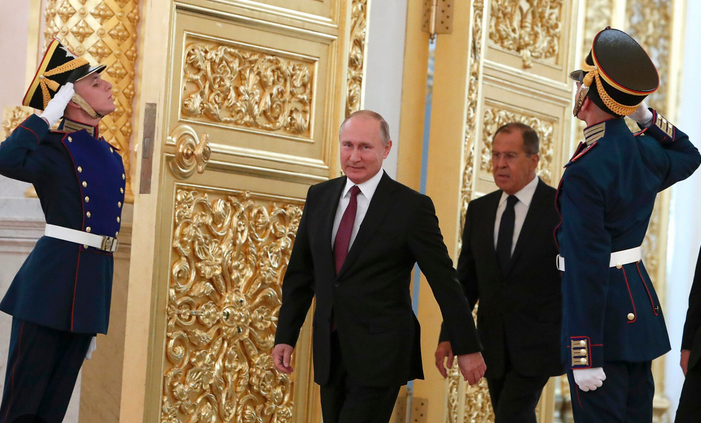
President Trump directed Secretary of State Marco Rubio to begin drafting plans for a tri-lateral peace summit which would include the United States, the Republic of Iran and the Russian Federation. Secretary Rubio advised against brining in Russia to create a trilateral summit given the fact that too many unresolved issues surround the war in Ukraine. He also stated that the talks with Iran should remain simple, clear and direct, he suggested that adding Russia would convolute the fragile initial talks. President Trump disagreed and instead insisted that Rubio continue with the planned summit, Secretary Rubio complied, and all envoys agreed to the date and location. Secretary Rubio arranged for the summit to be conducted in Istanbul, Türkiye against opposition from the EU and NATO. Named the Straits Initiative, the trilateral talks would mark the first direct US-Iran-Russia summit in decades. The “Straits Initiative” would be named for the strategic geography of the Turkish Straits and their importance as international waterways that mark the boundary between Europe and Asia.
The Straits Initiative
Late in the Summer of 2026, the Straits Initiative was conducted in Istanbul and lasted three days. The opening plenary sessions were mostly symbolic speeches, followed by strategic pairings which included US-Iran talks focused on sanctions, nuclear limits and regional deconfliction. The US-Russia talks focused on arms control and global energy stability. The war in Ukraine was not discussed as the Presidents decided to focus on building trust before delving into the sensitive nature of this divisive conflict. The last day of the summit focused on strategic arms limitations talks between the US and Russia, inspection protocols for the IAEA in Iran and the lifting of sanctions on Iran. In the final hour, the US agreed to lift targeted sanctions on Iran and Iran agreed to a limited nuclear transparency regime. Russia agreed to temporarily suspend strategic arms production and remove 1,999 warheads from its active arsenal. The US agreed to lift some of the targeted sanctions on Russia and remove 1,000 warheads from its active arsenal. The Initiative was converted to a multipolar cooperation pact. Much of the language indicated that the purpose of the pact is to dismantle the post-Cold war order and other global systems in order to create a “balance of civilizations”. The cooperation pact left an opportunity for other nations to join and sign the pact with specific reference to the People’s Republic of China (PRC).
Backlash
Upon formal announcement of the trilateral cooperation pact between the US, Iran and Russia, the World reacted in disbelief. The EU and Israel fiercely opposed the actions taken by the United States to act without their agreement and publicly decried that they were “blindsided” by President Trump’s actions. British Prime Minister Starmer and French President Macron met privately and later released a statement of concern, in the statement they said that the actions taken by the Trump administration had marked an official “death of the West’s unity”. Israel went publicly silent, but an intercepted report revealed that Israel had accelerated its covert operations against Iran.
A part of the cooperation pact included a “digital confidence framework”, this clause provided for a shared cyber and AI security cooperation agreement. Nothing was fully agreed upon or signed into action, but the language of the framework was very troubling to US tech giants, particularly Microsoft, Alphabet (Google) and Meta Sphere. The three tech giants agreed to collaborate in protest to the Trump administration, and a meeting was arranged in Mountain View, CA. At the meeting the titans agreed that they could not allow the digital confidence framework to be implemented as it would compromise intellectual property rights and ethics controls that have been established for public safety – at least that was the official narrative. Unofficially, they were not going to allow for algorithmic independence from their established reality, they had worked hard to build a digital landscape that the collective West understood and had come to accept. They proposed a collaborative campaign to undermine the process that would later be called the preamble to the “digital cold war”. Early efforts would include a disinformation campaign that would be created using off-grid technologies and manipulations of digital architecture embedded throughout multiple US government agencies.
Global Elite are Unhappy
Meanwhile in Geneva, Switzerland a high-level Bilderberg style meeting called together politicians from the EU, tech giant billionaires and thought leaders to discuss the Straits Initiative. This closed-door gathering was arranged to strategize a plan to dissuade participation in the initiative and to influence the outcome as peace is not in their playbook.
At the meeting in Geneva, they agreed that their devised strategy would manifest as quiet counsel as this may carry more weight than any formal opposition. In their counsel, they would not oppose peace outright but rather use public platforms to imply that the peace negotiations are rushed, unverified and even potentially dangerous for the general population. Fundamentally, they would frame a narrative through mainstream media and think tanks to alter the common perception that the Straits Initiative was good for stability.
Their three-pronged strategy would be pitched in three domains:
1) Militarily through representatives at NATO
2) Economically, through an appointed EU finance minister
3) Technology through Silicon Valley.
They will contend the following three main premises:
1. This method of careless peace planning is premature and destabilizing to the security of Europe.
2. This premature peace summit will disrupt markets, create supply chain uncertainty, spike or crash oil prices and threaten jobs in strategic industries.
3. This peace summit creates the opportunity for foreign intelligence to exploit the digital environment.
With this basic three-pronged strategic messaging campaign, they will attempt to create fractures in the unity of the Straits Initiative and thereby undermine the entire peace process.
The Geneva Ghost
What they didn’t know, was that a clandestine operative had already been monitoring activities like these in neutral Switzerland. Nicknamed the “Geneva Ghost”, this counteragent of sorts had infiltrated the highest levels of elite society. Based in Switzerland; the Geneva Ghost worked in Geneva, Davos, Montreux and Zurich where he monitored and reported all backchannel diplomatic talks, discussions and covert meetings. He routinely reported to a private agency backed by an eccentric philanthropist centered on high level disclosures. In this instance, the report was provided to the United States through clandestine services directly to the US Director of National Intelligence (DNI); Tulsi Gabbard. The Geneva Ghost knew the order of affairs in Washington, for this reason, he would only deal directly with the Trump administration.
Once received, the DNI immediately disclosed this information to President Trump’s Chief of Staff. President Trump called for a special envoy to travel to the United Nations Office at Geneva, Switzerland to assure them that the Straits Initiative would convene on schedule regardless of subversive actions taken. He knew that this information would make it to the people that needed to hear his message. The DNI and Secretary Rubio advised against this action, but President Trump was insistent. By making an egoic power play, Trump had forced the early resignation of the Geneva Ghost, as far as the United States was concerned, he was resigned. Unfortunately, this would eliminate what could have been a powerful ally for use against the newly discovered adversary. Nonetheless, his short-term strategy worked; now that the powers had been alerted, the plans to subvert the Straits Initiative had been softened, the Summit would be moving forward unimpeded.
Part Two Pathway to World Peace
New World Order?
The World’s architecture was falling apart, it was shedding the detritus of hegemony, nihilism, despair and global elitism. The global elite and their purveyors were now scrambling to keep it together. At the Euro-Tech Conference in Brussels, Belgium, Zuckerburg made the following statement: “Peace is just a market correction in slow motion. We adapt faster than governments can sign papers.” Statements like these were uttered at every opportunity by oppositional powers but they failed to plant the seeds of disharmony.
What Zuckerberg didn’t realize was that the Straits Initiative wasn’t just a trilateral agreement of empty rhetoric, it was the first step in achieving a balance of civilizations. The accord had emerged from a shared recognition that endless wars, political mistrust and economic strife had set the world on a path of destruction and despair, a path that may have led to the collapse of global order.
By the early Fall of 2026, the United States, Iran and Russia initiated the formalization of their new partnership, named the Trilateral Accord for Global Stability (TAGS). TAGS was unofficially named the “Peace Triad” throughout the journalism and social media space. The framework for peace was also formalized and officially named the “Balance of Civilizations.” The framework represented a diplomatic and philosophical realignment of how the global powers perceive sovereignty, cooperation and collective security.
Completing the Global Balance
The designers of the Straits Initiative – an international collaborative of think tanks, statesmen and military leaders realized early in the design stage that a true global balance could not be achieved without China. They had formulated that this balance could only be achieved if all four (4) civilizational centers were represented in the global balance. The United States would represent the West, Iran would represent the Islamic world, Russia, the Orthodox/Eurasian World and finally China would be required to represent the Sinic World.
It was believed that without China, the accord would appear more like a containment pact and not a true balance of the civilizations, as intended. The inclusion of China would legitimize the accord as a tool that could provide global equilibrium and not just a coalition of reactionaries, which was the perception held by critics.
The designers of the Straits Initiative first wanted to bring together the nations of the Trilateral Accord, gain popular opinion from the collective west and then propose the addition of the PRC as a viable solution to achieve a balance to our civilization. This methodology would gradually introduce the prospect of partnering completely with the PRC, a prospect that would have been considered an absurd proposition only a few short years prior. China is seen through the eyes of the collective West as an economic gravity with a powerful military, that seeks global domination. Even if true, the designers have the bold ambition of leveraging this economic gravity to the benefit of balancing the global order.
An ancillary benefit of bringing the PRC into the accord would be the technological counterweight that it would provide against Silicon Valley. As the tech giant opposition to the accords had grown to manifest into a unified campaign of opposition, this was big. China could help the alliance establish technological independence from the American tech giants through the use of its independent cloud. Furthermore, China’s cyber and satellite networks operated outside of Western control, most importantly, their state backed tech company; Huawei would bring AI capabilities which would cement digital sovereignty for the alliance.
Most importantly, the designers estimated that integrating China would once and for all resolve the question of strategic dominance throughout the World. The paradigm of continual competition among the world’s dominant powers would be dampened and the new civilization would eclipse the existing order. Instead of futile competition with China, the alliance would bring China in to enable a cooperative alignment meant to stabilize the World’s great powers through a formalized peace structure.
Framework: Accord for Global Stability
With the addition of China, the finalized framework would be Aligned by the four civilizational centers discussed previously. The final accord would be called simply the Accord for Global Stability (AGS). Each nation would contribute uniquely along six (6) primary lines of effort. Iran along three lines of effort, best suited for its reduced power and status in the World. Built directly into the accord framework (and not as a subset) would be the inclusion of sanctions relief packages for Iran and Russia from the United States. Called the Sanctions Pathways, these packages would provide for a graduated rollback of certain sanctions in exchange for verified strategic arms reductions and nuclear limits.
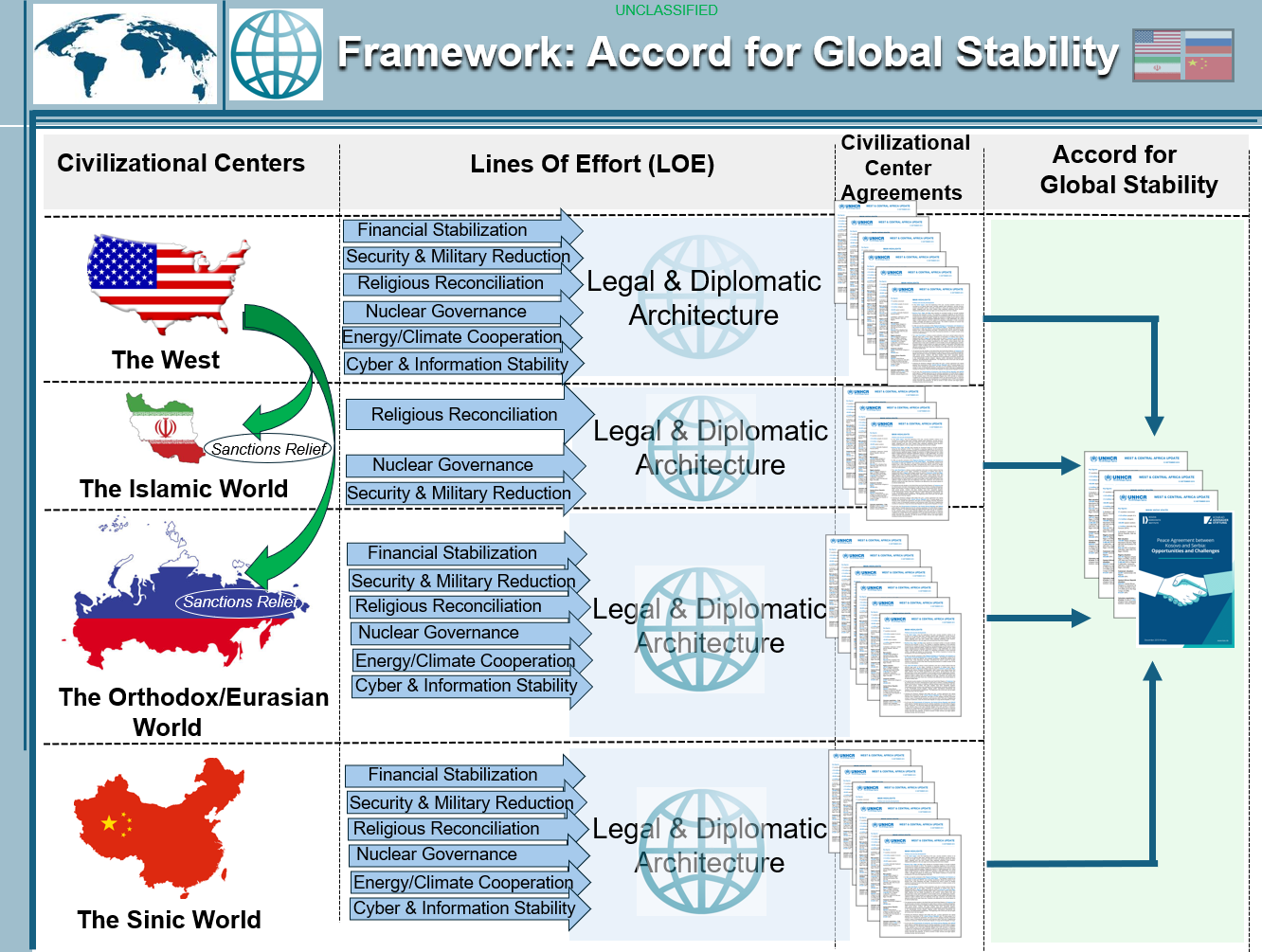
The financial stabilization line of effort would focus on energy market coordination and revitalized commercial trade corridors, primarily for the US, Russia and China. The security and military reduction line of effort would focus on missile and drone transparency measures, the formalization of a deconfliction communication system and the formation of a regional security council to address global flashpoints, such as the Persian Gulf and the South China Sea. Religious reconciliation would be centered on the establishment of an Interfaith Dialogue Council (IDC) with representation from American ecumenical bodies, the Catholic church, Shi’a clergy and the Russian Orthodox church. The nuclear governance line of effort would provide for a revitalized and more robust START Treaty with an enrichment and inspection regime subset established for Iran. The energy & climate cooperation line of effort would provide for a green technology trade corridor and an Iranian focused renewable build out to replace oil fired systems. With the growing relevance of arctic governance, rules for shipping lanes and environmental protections would also be covered in this line of effort. Finally, the cyber and information stability line of effort would include internationally recognized artificial intelligence safety guardrails that would be implemented globally by 2030. This line of effort would establish the requirement for the creation of a shared technical body to analyze and recommend the proper guardrails for managing artificial intelligence.
All lines of effort would be uniquely drafted into a suite of agreements for each civilizational center under an enforceable legal and diplomatic architecture. The architecture would ensure that the accord was enforceable and insulated from national strife and/or political swings that may affect continuing resolutions. The architecture would also serve as a mechanism for continued management through a non-interference codex which would protect the accord from regime changes or covert destabilization.
The four civilization center agreement suites would be compiled and codified into the actual Accord for Global Stability, a turning point which would define the new balance of civilizations and the new World.
Pathways: Accord for Global Stability
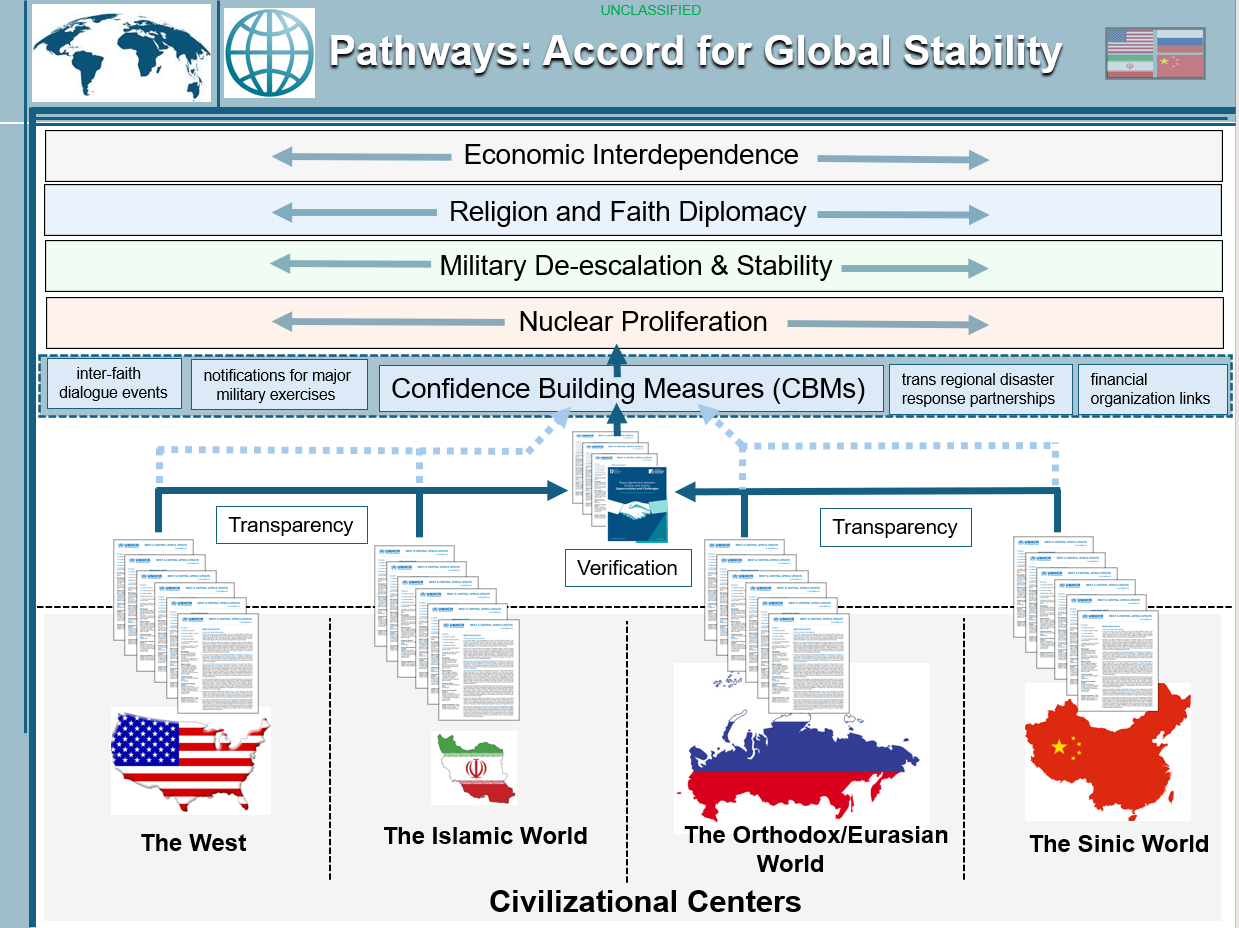
Once established, the accord would be implemented to principally follow four pathways; 1) nuclear proliferation, 2) military stability, 3) religious and 4) economic pathways. While the accord would not always be limited to these four pathways, it was determined that these pathways are most essential to be formalized. Not to be confused with Lines of Effort, the pathways are collaborative paths that work to unify the civilization centers through the AGS doctrinal structure. The LOEs are each nation’s specific contributions that work to serve the larger doctrine. While the LOEs are transparent among all members, the unifying doctrine itself would verify the contributions and align them to best serve the unification and balance among the civilization centers. The implementation structure would be built in such a way that additions can be made but nothing shall be removed. Common to many accords or formal peace structures are the early introduction of Confidence Building Measures or CBMs. CBMs serve as preliminary ice breakers for the building of cross-civilization structures, they set the conditions for the transition into a deeper institutional architecture. Examples of CBMs include military exercise notifications and routinized communications between militaries, inter-faith dialogue events and disaster relief partnerships. The CBMs are accommodated as subsets of the established pathways but are less regimented and with fewer protocols than the pathways. Subsequent development structures would further institutionalize and codify the AGS with the intent of solidifying partnerships. This stage may involve linking existing regional organizations, particularly useful may be economic linkages through interoperable protocols and data sharing. The tools and mechanisms used during all levels of partnership include transparency and verification as well as incentive structures and enforcement through disincentives.
China Signs
In an unprecedented meeting, delegations from the United States, Russia and Iran traveled to Beijing, China where they met the President of the PRC: Xi Jinping and Li Qiang, the Premier of the State Council, who is essentially the head of China’s executive branch of government. In a three-day introductory icebreaker meeting, the delegations met at the PRC’s Great Hall of the People and toured the infamous Zhongnanhai complex which houses the offices of China’s top state and party leaders. During the tour, the leaders were amicable and discussed a myriad of confidence building measures that could be enabled in the near term to hasten the multilateral partnership(s). The Chinese delegation was most interested in the possibility of activating financial organization agreements and solidifying existing linkages. The Western delegation expressed interest in enhancing transparency in military operations and enabling a notification system for military exercises and large-scale training events. On the final day of the meeting, the PRC delegation signed a preliminary draft that confirmed their commitment and permanent membership in the Accord for Global Stability. All delegations enjoyed amicable exchanges and a great deal of confidence building shaped the event to be a major success, an event that sealed the expansion of the Accord.
Part Three the Return of the Geneva Ghost
The Global Elite Double Down
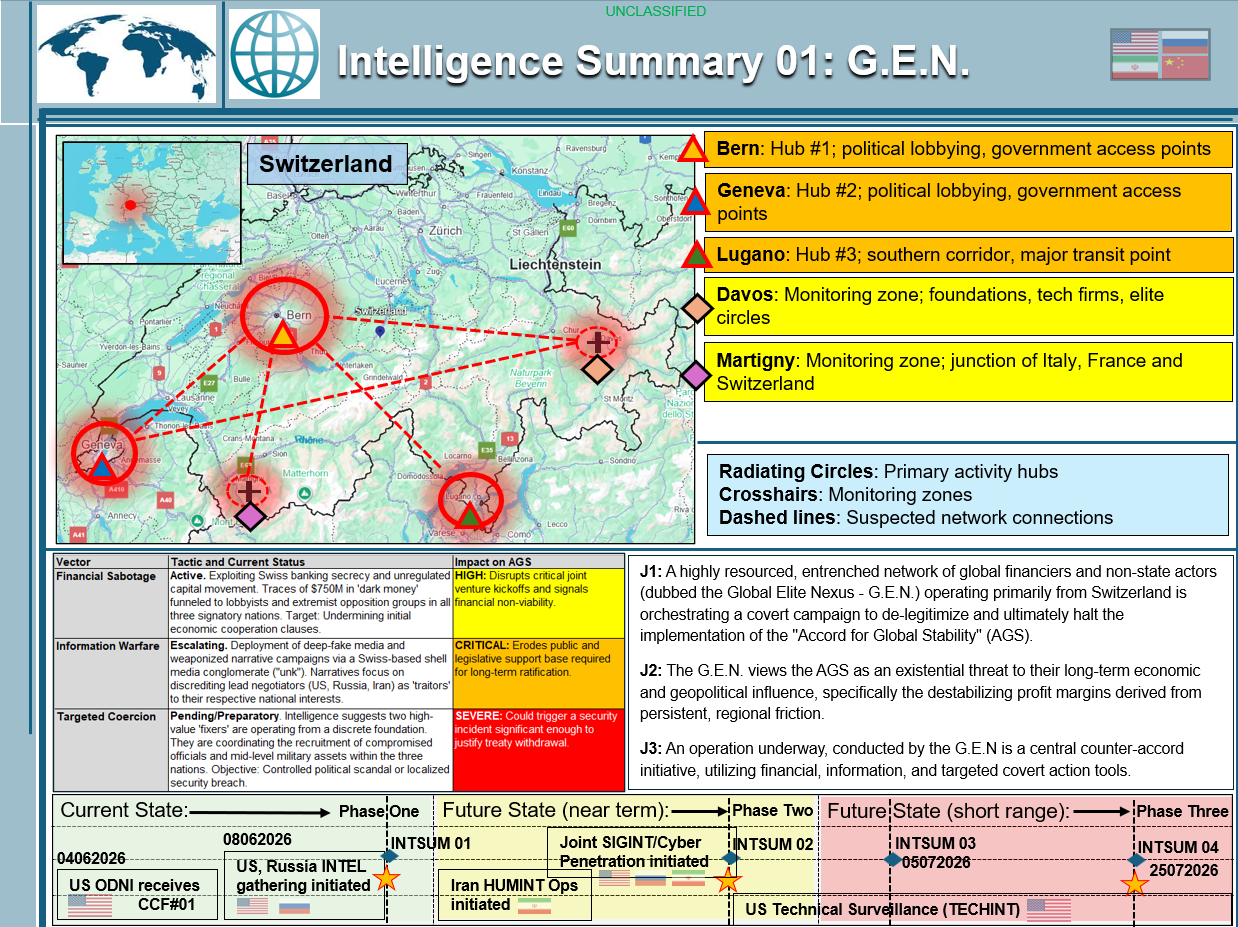
In the days following the meeting in Beijing, the elite powers scrambled to disrupt the World’s newly forming architecture. A few weeks after China signed the intent to join the AGS, the US White House received an encrypted wire, the wire included several files that were formatted in a Crisis Communication Format (CCF). The CCF provided immutable details that verified the sender, the location as well as much of the content of the message. It was unclear who sent the files but assumed to be the rogue spy named the Geneva Ghost. The content of CCF #01 included details that described a series of high-level Bilderberg type meetings that were being conducted in multiple locations throughout Switzerland. The meetings were being held to address the expansion of the Accord for Global Stability and one meeting included a decision-making agenda that was intended to launch a campaign to subvert the AGS. In the CCF, the concept of a structured quadrant was explained, a decentralized network of powerful blocs that would work in concert to destabilize and eventually subvert the AGS in its entirety. In this refreshed organizational structure, the quadrant would be comprised of 1. financial megabanks & funds, 2. transnational security and intelligence conglomerates, 3. big tech / data cartels, and 4. ultra-nationalist industrialists. Each of the four blocs would synchronize their efforts along ten primary lines of effort or vectors. A common method would necessitate close synchronization among all four blocs in order to employ a cascade strategy. By connecting small but coordinated disruptions they could bring systemic pressure while providing easily explainable individual disruptions. For instance, by coordinating a power outage with a diplomatic miscommunication and a border skirmish all simultaneously they could break the peace through an accumulation of non-attributable issues. CCF #01 also revealed the narrative arc that would be used to conduct the subversion through deliberate stages. Following a crawl-walk-run methodology, they would first work to erode partnerships through disinformation, they would move on to planting the seeds of distrust by forging messages showing disrespect or bad faith among the leaders of the civilization centers. Later stages would include more invasive techniques designed to fragment and trigger a crisis through a major sabotage event for instance. Additional files included annexes that explained the proposed methods of subversion with detailed files explaining the concept of information warfare seeding. Most troubling was a document that explained how the designed collapse of the accord would facilitate a renewal of the campaign to bring multipolar conflict to all of the world’s civilization centers.
The Response
Realizing the importance of this verified communication, the Trump administration moved quickly to notify the Kremlin and the Office of the Supreme Leader of Iran that this campaign of subversion was working to subvert the AGS. Upon receipt, the Kremlin requested a virtual meeting with the White House to discuss an approach to address the potential threat. The Office of the Supreme Leader of Iran also expressed interest in meeting with the US and Russia to discuss the threat. An encrypted video teleconference was arranged by the Office of the Director of National Intelligence (ODNI), as the principal intelligence advisor to the President, the Director and staff would be briefing the leaders of Russia and Iran on the details and content of CCF #01. At the encrypted video teleconference, the Director of National Intelligence explained all relevant details of the Crisis Communication Format #01 and the content along with all attached annexes. President Pezeshkian expressed serious concern regarding this development, but President Putin, being true to his character, was largely non-reactive and acted almost as if he had anticipated this development. It was decided that a joint response would be formulated in the near term and in the interim, it was decided that formal recruitment should be offered to the Geneva Ghost. On the advice of the Office of the Director of National Intelligence, it was proposed by the Trump administration that the priority should be the continual monitoring of the situation unfolding in Switzerland. The US ODNI was tasked with contacting and recruiting the individual nicknamed the Geneva Ghost while the Russian Federation Foreign Intelligence Service (SVR) would pursue additional intelligence gathering. Supported by Russia’s Main Directorate of the General Staff (GRU), Russia’s clandestine operatives would be primarily collecting Human Intelligence (HUMINT) and Signals Intelligence (SIGINT) throughout Switzerland. While Russia’s agencies don’t limit their intelligence gathering operations to covert operations, in this instance, it was decided that an abundance of caution should be exercised.
The Benevolent Philanthropist
Following the release of the intelligence summary, the ODNI began to research the origins of the CCF#01 in an effort to track down the source known as the Geneva Ghost. Signals intelligence specialists found transaction lines that tied back to a wealthy philanthropist known for benevolent activities in the Euro-Atlantic region. Mr. Travis Shackelford is well known for supporting high risk research programs such as genomic studies, pandemic preparedness and has purchased large tracts of land in order to prevent development, which he later converted into “rewilding” zones. Analysts uncovered a contractual agreement that tied Mr. Shackelford to the Geneva Ghost. Instead of inquiring about the Geneva Ghost directly, the ODNI contacted Mr. Shackelford and invited him to join their intelligence team with exclusive access to other aspects of the larger accord. Mr. Shackelford did not agree to join outright but he did request a special meeting with the U.S. DNI herself to discuss the matter firsthand.
At the meeting, Mr. Shackelford confirmed that the Geneva Ghost was indeed under his employ, he explained that they had a special relationship, more than transactional, one that was based on an alignment of higher ideals and benevolent vision. Mr. Shackelford went on to explain that he and the Geneva Ghost had collaborated to defend the AGS at all costs, they further agreed to keep their support clandestine in nature. By remaining clandestine in all their activities, they would avert attention from adversaries, ironically, they could influence outcomes to a greater degree and most importantly, stay true to their cause. The DNI, Ms. Tulsi Gabbard, acknowledged the nobility of these actions and invited Mr. Shackelford to officially join the US intelligence team to support the AGS. Mr. Shackelford frustratingly denied and explained once again that he and the Geneva Ghost must maintain radical anonymity. Their anonymity had been exposed temporarily by the President earlier in the year, when he had dispatched an envoy to Switzerland to intercede in the lead up to the Straits Initiative. This unfortunate incident soured the chance of any formal relationship that could have been established between the administration and the clandestine team. Mr. Shackelford assured the DNI that they would continue to provide indirect support to the intelligence, counter-intelligence effort with the intent of mitigating any and all obstructions to the progress of the AGS. In vague terms, he went on to explain that the content, methods of delivery and timing of support would be conducted under their terms in order to maintain plausible deniability and protect assets. The DNI agreed to the terms and conditions and extended an offer of resources and other assets as appropriate to Mr. Shackelford and the Geneva Ghost. After the meeting, the ODNI back briefed her counterparts at the Russian Federation and the Islamic Republic of Iran.
Part Four Structure Emerges
The Trilateral Operations Center (TOC)
In the days that followed, the trilateral operations center, temporarily located in Washington DC, increased its operational rhythm, gained staff members and as its capabilities increased, it began to go on the offensive. With no unified command structure, the ops center took on a life of its own and began the planning of counterintelligence (CI) activities to get ahead of the G.E.N campaign. The Russian SVR liaison in DC and the US ODNI conditionally approved the use of CI, the condition being that all proposals had to be approved and communicated to their newest “silent partner” before execution. Their first priority was the identification of compromised officials and mid-level military assets from within the participating nation states of US, Russia and Iran. The reason being that compromised officials could trigger a security incident significant enough to justify treaty withdrawal. The identification of these individuals was paramount; additional steps would be taken later to neutralize their efforts. Secondly, the “fixers” that were conducting the recruiting activities from the GEN would need to be identified and neutralized. Lastly, but not finally, an AI disinformation shield would be needed, this is a protective measure meant to identify and counter false narratives that could be working to destabilize social trust in the accord.
As functional area alignments took shape, departments began to form and eventually an interim command structure brought about unified operational objectives under the larger operations center umbrella. The operations center planning team established a current, near-term and short-range planning calendar with at least one trilateral operation scheduled. The intelligence centers of the three nation states began to coalesce as the synchronization of all activities was prioritized.
Leadership Structure
The organizational hierarchy of the AGS had begun to manifest and a visible governing body began to manage the day-to-day affairs of the AGS. Primarily comprised of each nation’s foreign ministers, the Ministerial Council was responsible for translating the broad goals into policy, this work became the day-to-day work during the early stages of implementation. This body of work would require the formation of technical working groups and daily meetings with sub committees to focus on friction points such as nuclear proliferation and the water rights of the Persian Gulf. Aligned with the Trilateral Operations Center, the Cooperation Secretariat formed the administrative backbone of the structure. Ideally, the Cooperation Secretariat would be located in a neutral location, but like many things in the AGS due to uncertainty and operational risk factors, the interim default location would be Washington DC. The secretariat soon became the operational hub for unclassified matters as this entity took on the daunting tasks of managing trilateral schedules, coordinating communications and the establishment of early budget proposals. One of the principal tasks of the Ministerial Council would be the establishment of an enforcement body, a component that would provide monitoring, verification and reporting to the Ministerial Council of violations and/or major breaches of protocol as they pertain to the AGS pathways. This may be one of the more important tasks of the Ministerial Council since peace accords usually fail because they lack sufficient enforcement mechanisms. Under this body, regulating authorities would manage each of the pathways with appropriate representation from each one of the disciplines. For instance, a former executive director within the IAEA would manage the nuclear proliferation pathway, while active-duty senior military officers from each of the branches within each nation state would manage the military de-escalation pathway. Given the rapid growth and semblance of permanence that had emerged, it had become apparent that a neutral physical home for the AGS would be needed. A committee was formed to seek out a permanent headquarters for the AGS, its leadership and all associated functional activities that are normally assigned as part of a headquarters organization. Candidate locations for the headquarters included: 1) Qatar, 2) the United Arab Emirates, 3) Bulgaria, and 4) Spain. Site surveys of European locations outside of Spain resulted in significant resistance from local and regional authorities. The European Union has never been a proponent of the AGS and while considered for membership, intelligence indicates that it has unofficially aligned with the Global Elite Nexus.
End Book One
Please join me for book two. In book 2, China enters the AGS as a full member, the EU formalizes a partnership with the GEN and internal strife threatens to weaken the alliance.
Acronyms and Abbreviations
AGS — Accord for Global Stability
AIPAC — American Israel Public Affairs Committee
CBM — Confidence-Building Measure
CCF — Crisis Communication Format
CI — Counterintelligence
DNI — Director of National Intelligence
DOJ — Department of Justice
EU — European Union
FARA — Foreign Agents Registration Act
GBU — Guided Bomb Unit
GEN — Global Elite Nexus
GRU — Russian Military Intelligence (Glavnoye Razvedyvatelnoye Upravlenie)
HASC — House Armed Services Committee
HUMINT — Human Intelligence
IAEA — International Atomic Energy Agency
IDC — Interfaith Dialogue Council
LOE — Line of Effort
MQ — Multi-role / Quasi-unmanned Aircraft System
NATO — North Atlantic Treaty Organization
NEF — New Equipment Fielding
ODNI — Office of the Director of National Intelligence
PRC — People’s Republic of China
SIGINT — Signals Intelligence
START — Strategic Arms Reduction Treaty
SVR — Russian Foreign Intelligence Service (Sluzhba Vneshney Razvedki)
TAGS — Trilateral Accord for Global Stability
TECHINT — Technical Intelligence
TOC — Trilateral Operations Center
Terms & Explanations:
AIPAC: The American Israel Public Affairs Committee (AIPAC) is a pro-Israel lobbying group that advocates its policies to the legislative and executive branches of the United States. It is one of several pro-Israel lobbying organizations in the United States, and has been called one of the most influential lobbying groups in the U.S.
BILDERBERG: The Bilderberg Meeting (also known as the "Bilderberg Group", "Bilderberg Conference" or "Bilderberg Club") is an annual off-the-record forum established in 1954 to foster dialogue between Europe and North America. The group's agenda, originally to prevent another world war, is now defined as bolstering a consensus around free market Western capitalism and its interests around the globe. Participants include political leaders, experts, captains of industry, finance, academia, numbering between 120 and 150.
GRU: stands for Glavnoye Razvedyvatelnoye Upravlenie, meaning Main Intelligence Directorate, and is Russia's primary foreign military intelligence agency, operating under the Ministry of Defense. It collects military, technical, economic, and political intelligence globally, utilizing spies, cyber operations, and its own special forces (Spetsnaz) to support Russian defense and policy, often linked to major covert actions.
HASC: House Armed Services Committee is a standing committee of the United States House of Representatives. It is responsible for funding and oversight of the Department of Defense (DoD) and the United States Armed Forces, as well as substantial portions of the Department of Energy. Its regular legislative product is the National Defense Authorization Act, which has been passed by Congress and signed into law each year since 1962.
SINO: The Sino or SINIC world refers to the civilizational sphere shaped by Chinese culture, philosophy, governance, and language over thousands of years. It encompasses regions and peoples historically shaped by Confucian ethics, Chinese writing, political models, and worldview.
SVR: stands for Sluzhba Vneshney Razvedki, is the Russian abbreviation for the Foreign Intelligence Service of the Russian Federation, Russia's primary external intelligence agency responsible for gathering intelligence and conducting operations outside its borders to protect national security from foreign threats, operating under the direct oversight of the President of Russia.
X: formerly known as Twitter, is an American microblogging and social networking service. It is one of the world's largest social media platforms and one of the most-visited websites. Users can share short text messages, images, and videos in short posts (commonly and unofficially known as "tweets") and like other users' content.
